
Building muscle memory for drone piloting is essential because it enables you to respond quickly and instinctively during complex maneuvers. With consistent practice, your body learns to execute movements automatically, improving your reaction times and overall safety. This instinctual capability allows you to focus on strategy and decision-making rather than basic controls, which is important during competitive flying. Techniques like repetition and timing drills further enhance your skills, providing measurable progress. Additionally, using simulators can accelerate learning in a risk-free environment. By honing your muscle memory, you'll elevate your piloting abilities considerably, setting the stage for further insights to come.
Importance of Muscle Memory
In the world of drone piloting, muscle memory plays a pivotal role in your performance. When you practice consistently, you develop the ability to execute complex maneuvers instinctively, such as the Power Loop or the Matty Flip. This instinctual response reduces your reaction time during races or critical operations, making you a more effective pilot.
As you repeat flying techniques, you'll notice smoother and faster lap times, which greatly enhances your overall performance. Consistent practice is key to building this muscle memory. It allows your subconscious actions to take charge, enabling you to navigate challenging track sections without needing to think about each move.
This frees up your mental space, allowing you to focus more on strategy and competition. Engaging in timing drills can further reinforce your muscle memory, highlighting the importance of precision and speed in your flight operations.
Mastering muscle memory not only polishes your piloting skills but also promotes safer drone operations. As you become more attuned to your drone's behavior and handling characteristics, you'll make quicker, more informed decisions.
Techniques for Building Muscle Memory
To build muscle memory effectively, you need to focus on repetition in your practice sessions. By consistently performing the same maneuvers, you'll train your body to respond instinctively and efficiently.
Practicing in open spaces, as suggested in choosing the right drone, helps reduce crash risk and allows for better focus on each movement. Incorporating focused maneuver drills can further enhance your skills, allowing you to master the intricacies of flying with greater precision.
Repetition in Practice
Regular practice is key to mastering drone piloting, as it directly builds the muscle memory necessary for executing maneuvers with speed and precision. Engaging in essential equipment for drone racing is important to guarantee that you have the right tools to practice effectively.
Repetition is critical; the more you practice, the better your muscle memory becomes. Start by focusing on slow and smooth techniques during your sessions. This approach helps embed subconscious actions, making them easier to execute at higher speeds later.
Engaging in specific timing drills allows you to track your progress and enhance your speed, reinforcing the muscle memory you need for faster lap times. Consistent practice not only builds muscle memory but also fosters a deeper understanding of drone handling and control.
As you develop your skills, you'll notice an improvement in your overall performance. Additionally, utilizing drone racing simulators can effectively simulate real-world scenarios, aiding in your development of quick response skills and muscle memory.
Focused Maneuver Drills
Practicing focused maneuver drills is essential for developing muscle memory in drone piloting. These drills allow you to practice specific movements repeatedly, making them second nature.
By running drills on challenging sections of a track, you'll become familiar with difficult maneuvers, enhancing your overall piloting skills and speed.
Utilizing drone racing simulators can help you simulate various scenarios, providing a safe environment to refine techniques without the risk of crashing.
Consistent practice is key; steering through gates without conscious thought is vital for building the subconscious actions necessary for quicker and more efficient flying.
Incorporating timing drills into your routine serves as a measurable benchmark for tracking progress. You can identify areas for improvement in your maneuvering skills, ensuring you're always advancing.
These focused maneuver drills greatly improve your navigational efficiency, allowing you to traverse complex environments with ease.
Role of Repetition in Training
When it comes to mastering drone piloting, repetition really makes a difference. Engaging in consistent practice helps you develop muscle memory, allowing you to perform complex maneuvers with increased speed and accuracy.
As you repeat your training sessions, you establish subconscious actions, which means you can focus on strategic decision-making during races rather than getting caught up in the basics.
Slow and smooth techniques during practice are key to enhancing your muscle memory. The more familiar you become with your drone's responsiveness, the faster you'll achieve better lap times.
Timing drills also play an important role; they serve as benchmarks for your progress, enabling you to track improvements in your speed and efficiency through repeated practice.
Mastering specific maneuvers through repetition not only builds your confidence but guarantees you can execute intricate tasks without conscious thought, especially during competitive events.
Ultimately, the role of repetition in your training is crucial. It transforms your performance, making you a more skilled and reliable drone pilot.
Embrace the power of practice, and watch your abilities soar as you refine your craft.
Benefits of Manual Flying
Manual flying offers considerable advantages that elevate your piloting skills to a new level. By mastering manual control, you greatly enhance your situational awareness, allowing you to react quickly and effectively to changing environments. This skill improves your overall performance and contributes to safer operations, particularly when automation might fail.
Production teams often seek pilots who can demonstrate strong manual flying skills, as these abilities reduce reliance on automated features. When you understand your drone's behavior through manual control, you build confidence in handling complex maneuvers. This mastery not only makes you a more capable pilot but also prepares you for unexpected challenges during flight.
Regular practice of manual flying develops muscle memory, leading to improved precision and control in your piloting. The more you engage in manual flying, the more instinctive your reactions become, allowing you to execute movements with fluidity and accuracy.
In the long run, this practice not only enhances your skills but also makes you a more attractive candidate in the competitive field of drone piloting. Embracing manual flying will certainly set you apart as a skilled and reliable pilot.
Navigating Complex Tracks
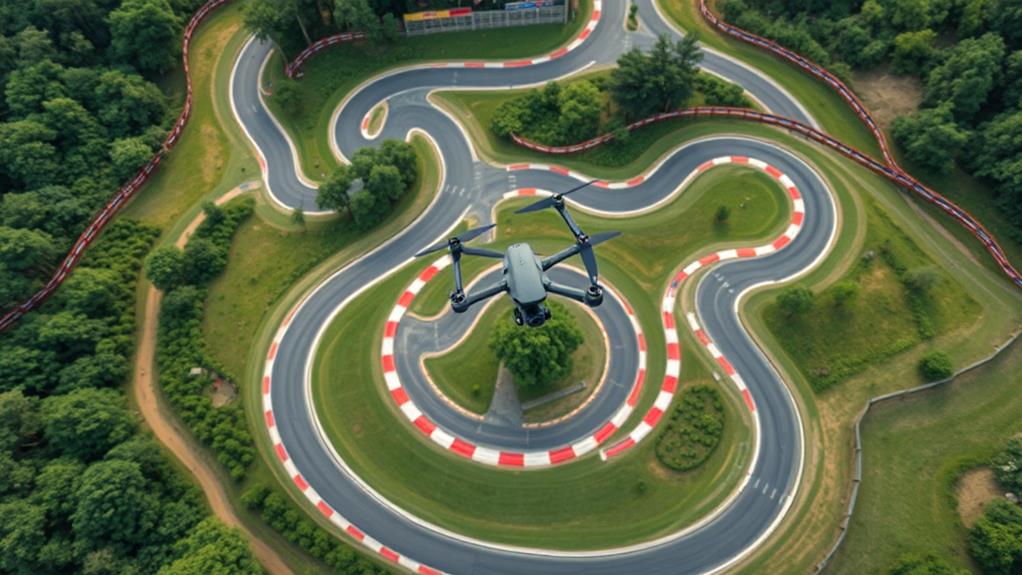
Maneuvering complex tracks demands consistent practice to sharpen your skills and boost your confidence.
Focusing on techniques for smooth maneuvering and enhancing your spatial awareness can drastically improve your performance.
As you tackle different obstacles and refine your maneuvers, you'll find that muscle memory becomes your greatest ally in mastering those tricky sections.
Importance of Consistent Practice
Consistent practice is essential for mastering the complexities of drone piloting, especially when tackling intricate tracks. Developing muscle memory allows you to navigate these challenging courses with greater ease and speed. By regularly running specific drills on difficult sections, you build familiarity and confidence in executing maneuvers effortlessly. This repetition is vital for enhancing your overall performance.
Utilizing drone racing simulators in your practice routine can greatly accelerate your learning. These simulators provide a risk-free environment, allowing you to refine your skills without the pressure of real-world consequences. They enable you to experiment with different navigation strategies and techniques, making practice more effective.
To gauge your improvement, engage in performance tracking through timing drills. This approach provides measurable benchmarks that highlight both your progress and areas needing improvement.
As you repeatedly navigate gates and obstacles, you'll notice that your reactions become more instinctive, enabling you to respond swiftly and accurately during competitive events.
Techniques for Smooth Navigation
When tackling complex tracks, mastering smooth maneuvering techniques is essential for any drone pilot. Developing muscle memory through consistent practice allows you to handle intricate courses with precision.
Here are four effective techniques to enhance your maneuvering skills:
- Slow and Steady: Focus on slow, smooth movements when maneuvering tight spaces. This helps you build muscle memory and enhances control.
- Targeted Drills: Run specific drills on challenging sections of a track, like gates or turns, to improve your precision and confidence.
- Utilize Simulators: Drone Racing Simulators provide a safe environment to practice without risking your equipment. They allow you to experiment with different maneuvering techniques.
- Timing Exercises: Incorporate timing drills to benchmark your skills. This helps you track your progress and identify areas for improvement.
Enhancing Spatial Awareness Skills
Mastering spatial awareness is essential for anyone looking to excel in drone racing, especially on complex tracks filled with obstacles. By developing muscle memory through consistent training, you'll navigate these intricate layouts with ease, allowing for quicker reactions to sudden changes in your environment.
Focusing on specific sections of the track during practice enhances your spatial awareness, enabling you to instinctively respond to gates and obstacles.
Incorporating timing drills into your routine provides measurable benchmarks, highlighting improvements in lap times and maneuver efficiency. These drills reinforce your muscle memory, making it easier to maintain control during high-speed races.
Additionally, using drone racing simulators offers a fantastic way to practice in challenging virtual environments. This helps you anticipate spatial challenges and respond in real-time, sharpening your skills further.
Mastering smooth, controlled maneuvers is vital for improving your overall performance. As you refine these techniques, you'll find that your spatial awareness improves considerably, resulting in faster and more precise navigation.
Ultimately, consistent practice in these areas will elevate your drone racing abilities, giving you the edge needed to compete effectively on any complex track.
Utilizing Drone Racing Simulators
Drone racing simulators offer an exciting way to sharpen your piloting skills in a risk-free environment.
By utilizing these simulators, you can build muscle memory and improve your performance without the fear of crashing a physical drone.
Here are four key benefits of using drone racing simulators:
- Realistic Physics: Simulators often mimic the dynamics of real-world flying, helping pilots grasp the intricacies of drone racing.
- Timed Challenges: Many simulators feature timed courses that allow you to track your progress and refine your lap times as you develop your skills.
- Customizable Settings: You can adjust various difficulty levels to suit your experience, whether you're a beginner or an advanced pilot looking to enhance specific skills.
- Complex Courses: Practicing on intricate layouts helps you navigate challenging environments instinctively, reducing the need for conscious thought during actual races.
Measuring Progress and Performance
As you sharpen your skills in drone racing simulators, measuring your progress and performance becomes essential to your growth as a pilot. Timing drills play an important role in tracking your performance, allowing you to compare track times and identify specific areas for improvement. By consistently practicing, you develop muscle memory that helps you navigate gates and obstacles more efficiently.
Using simulators provides a controlled environment where you can focus on practice drills tailored to your needs. Isolating challenging sections of a track enables you to systematically improve your skills through targeted repetition. This focused approach helps you build confidence and refine your techniques.
Documenting your performance metrics over time is significant, as it allows you to visualize your progress. By comparing your results against performance benchmarks, you can set realistic goals and stay motivated in your drone racing journey.
Community Support and Resources
The vibrant community surrounding drone racing is a crucial asset for pilots at all skill levels. With organizations like MultiGP, you'll find an inviting space that fosters growth through community support and training resources.
Here's how you can benefit:
- Networking Opportunities: Join over 30,000 registered pilots to connect and learn from one another, enhancing your career prospects in drone racing.
- Competitive Gatherings: Participate in structured competitions where you can test your skills and gain valuable experience against fellow drone pilots.
- Casual Events: Enjoy informal meet-ups that allow you to practice and socialize, making the learning process enjoyable and less intimidating.
- Training Resources: Access extensive tools and guidance provided by MultiGP, designed to help both new and experienced pilots develop their skills effectively.
These community-driven initiatives sustain a dynamic racing culture. They encourage participation, allowing you to grow, share knowledge, and celebrate achievements with fellow enthusiasts.
Engaging in these activities not only builds your muscle memory but also strengthens your connection to the drone racing world. Embrace this supportive network to take your piloting skills to new heights.
Conclusion
Building muscle memory in drone piloting is essential for mastering controls and enhancing performance. By practicing consistently, you can navigate complex tracks with ease, just like a competitive racer who dedicates hours to simulators and real-life flights. For instance, a high school student who commits to daily practice can improve their race times markedly, gaining confidence and skill. Embrace repetition, and you'll find that your flying abilities will elevate, making each flight a more enjoyable experience.
Leave a Reply