
To master drone flight, you need a firm grasp of aerodynamics. Understanding key forces—lift, thrust, drag, and weight—is essential for stable operation. For fixed-wing drones, lift comes from pressure differences across wings, while multirotors achieve it through propeller rotation. Higher lift-to-drag ratios indicate better efficiency. Environmental factors like wind and humidity also play significant roles, impacting performance. Techniques such as adjusting propeller speeds and using advanced simulations can help optimize stability. By enhancing your knowledge of these concepts, you'll improve your flight skills and efficiency, paving the way for further insights into advanced drone capabilities.
Importance of Aerodynamics in Drone Flight

When it comes to drone flight, understanding aerodynamics is essential for ideal performance. Aerodynamic design plays a fundamental role in shaping how effectively your drone operates. For instance, fixed-wing drones generate lift through pressure differences across their wings, while multirotor drones depend on the rotation of their propellers to achieve lift generated. This distinction is important as it influences how you'll manage your drone in different environments.
Additionally, the type of drone you choose, whether it's a quadcopter or a racing drone, can further affect its aerodynamic characteristics. The lift-to-drag ratio (L/D ratio) is another key factor to keep in mind. A higher L/D ratio indicates better aerodynamic efficiency, with advanced drones, like the Chinese hypersonic model, boasting impressive figures at subsonic speeds. Streamlined designs minimize drag, which is essential for maintaining efficient flight. You need to make certain that lift exceeds the total weight of your drone while balancing against drag.
Moreover, environmental factors, such as wind, can greatly affect drone performance. Headwinds increase drag, potentially slowing you down, while tailwinds can boost your speed. By understanding these aerodynamic principles, you can make informed adjustments to your flight plans and enhance your overall drone performance.
Key Forces Affecting Drone Performance
Understanding the key forces affecting drone performance is essential for every pilot aiming to master their craft. Drones operate under four primary aerodynamic forces: lift, thrust, drag, and weight. Among these, lift is vital, as it counters gravity and allows your drone to ascend.
In multirotor designs, lift is generated by the rotation of propellers, creating pressure differences that elevate the drone. Additionally, a solid grasp of advanced aerial movements can enhance your ability to maneuver effectively during flight.
Thrust, on the other hand, is produced by the propulsion system and propels your drone forward. In multirotor drones, you can adjust the speed of the propellers to control the amount of thrust generated, enabling you to navigate effectively.
It's important to note that drag opposes your drone's forward motion. By utilizing streamlined designs, you can reduce drag, enhancing overall flight efficiency.
For stable flight, the lift produced must exceed the total weight of your drone, making the balance of weight and drag critical for peak performance. Understanding how these forces interact won't only improve your flying skills but also guarantee safer, more efficient flights.
Techniques for Optimizing Flight Stability

Optimizing flight stability is vital to achieving smooth and controlled drone operations. One major factor is proper weight distribution; an unbalanced load can lead to oscillations and a loss of control. Make certain to evenly distribute components, as this enhances stability.
Multirotors can adjust the speed of individual propellers to counteract disturbances like wind, helping to maintain that essential upward force. Moreover, advancements in technologies like 5G Connectivity are set to enhance pilot responsiveness, which is important for maintaining stability during high-speed maneuvers.
Incorporating effective control systems, such as PID (Proportional-Integral-Derivative) controllers, can automatically correct deviations in altitude and orientation, allowing for a more stable flight experience. Additionally, focus on aerodynamic designs that minimize drag. Streamlined shapes and optimized propeller configurations can greatly contribute to overall stability during flight.
Regularly conducting simulations using data collection and analysis is fundamental. Experiment with varying parameters like forward tilt angle and propeller RPM, as these tests help identify ideal conditions for stability and performance enhancements.
Environmental Factors Influencing Aerodynamics
Environmental conditions play an essential role in a drone's aerodynamic performance. Understanding how these environmental factors influence drone flight is critical for maximizing your flight paths and ensuring stable operation.
Here are a few key aspects to take into account:
- Wind Effects: Headwinds increase drag, while tailwinds can enhance speed, requiring you to adjust your flight plans accordingly.
- Crosswinds: These lateral forces can cause drift, pushing your drone off course. You'll need to compensate actively for this during flight.
- Temperature and Humidity: Changes in these factors can alter air density, affecting lift generation and overall drone performance.
Monitoring these environmental factors is essential for safe operation. They can greatly impact lift, drag, and thrust, directly influencing how efficiently your drone flies.
For instance, flying in high humidity could mean reduced performance, while flying in colder temperatures might enhance lift.
By staying aware of these conditions, you can make informed decisions, adjusting your techniques to maintain favorable flight stability.
Advanced Simulation Tools for Training
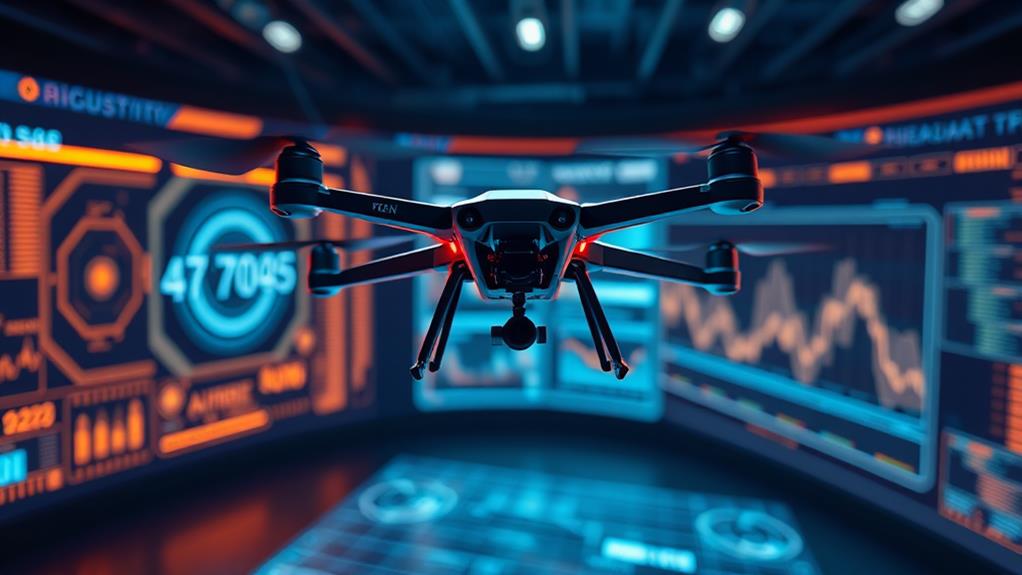
Mastering drone flight involves not only grasping the impact of environmental factors but also leveraging technology to enhance your skills.
One effective way to do this is through advanced simulation tools, like those designed for the DJI Phantom 3D model. These tools enable you to analyze the aerodynamics of your drone without oversimplifying complex models that can include up to 10,000 components.
Simulations can be categorized into three types: basic, regular, and advanced. Advanced simulations provide detailed insights into airflow, utilizing 50-100 million cells for peak performance evaluation.
During these simulations, the software automatically calculates propeller rotations, typically set around 12,000 RPM, to guarantee accurate thrust requirements at a forward tilt angle of 15° and a speed of 50 km/h.
Conclusion
Mastering drone flight involves a solid understanding of aerodynamics, which plays an essential role in performance. Did you know that optimizing a drone's design can improve its flight efficiency by up to 25%? By considering the key forces at play, employing stability techniques, and accounting for environmental influences, you can enhance your flying skills greatly. Utilizing advanced simulation tools will further refine your abilities, making you a more competent and confident drone pilot. Happy flying!
Leave a Reply