
Mastering speed and control in drone training is essential for executing dynamic aerial maneuvers and capturing unique footage. You'll need to familiarize yourself with your controller's layout and practice basic maneuvers like stable hovering and smooth turns. Utilizing FPV simulators can enhance your skills in a risk-free setting, allowing for practice without fear of crashes. Understanding drone dynamics, including roll, pitch, and yaw, is vital for precision in flight. Regular sessions build muscle memory and improve reaction times, ensuring you can adapt to varying conditions effectively. As you progress, you'll access more advanced techniques and capabilities to elevate your flying.
Importance of Speed and Control
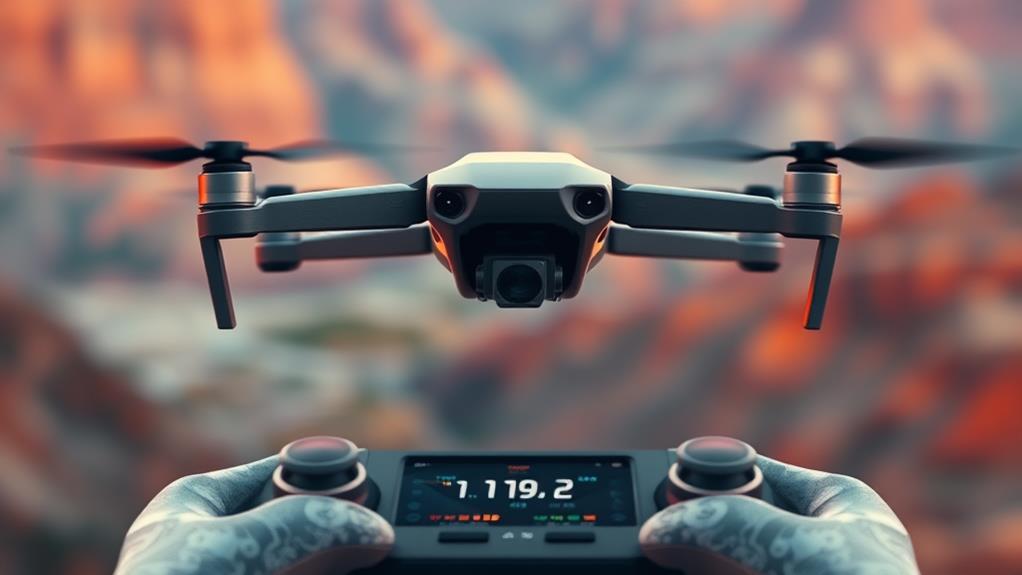
When flying a drone, mastering speed and control is essential for executing complex maneuvers effectively. Your ability to manage speed and direction directly impacts the drone's responsiveness and stability during flight.
Understanding how throttle control affects altitude helps you maintain a steady flight path, ensuring smoother shifts between speed and elevation changes. By incorporating innovative techniques in action, you can enhance your understanding of how speed and control contribute to maneuvers like the Power Loop and Matty Flip.
Accurate speed adjustments allow you to navigate through an obstacle course and execute cinematic shots, enhancing your drone performance. Practicing controlled speed variations develops your piloting skills, improving reflexes for unexpected changes in flight conditions, like wind or sudden turns.
As you progress to advanced flight modes, such as Sport Mode, you'll find that a higher level of speed and control mastery is vital. These aggressive maneuvers require a solid foundation in control inputs and responsiveness.
Essential Training Techniques
Mastering the fundamentals of drone flight relies heavily on essential training techniques that lay the groundwork for advanced maneuvers. To become proficient in drone flying, you need to familiarize yourself with the controller layout, focusing on the four primary controls: roll, pitch, yaw, and throttle.
These controls enhance your responsiveness and precision, vital for engaging in competitive racing and maneuvering tight spaces understanding FPV drone racing.
To build your skills as a pilot, practice flying basic maneuvers, such as:
- Stable hovering
- Forward and lateral movements
- Smooth shifts between turns and straight paths
- Regular monitoring of battery life
- Awareness of weather conditions
These techniques are important for developing coordination and overall flying proficiency. Engaging in consistent practice sessions allows you to refine your control sticks and enhance your muscle memory.
Utilizing flight simulators can also provide a risk-free environment for you to hone your skills without the fear of damaging your drone. Remember, adverse weather conditions and low battery levels can greatly impact your drone's performance, so always keep an eye on those factors.
Utilizing FPV Simulators
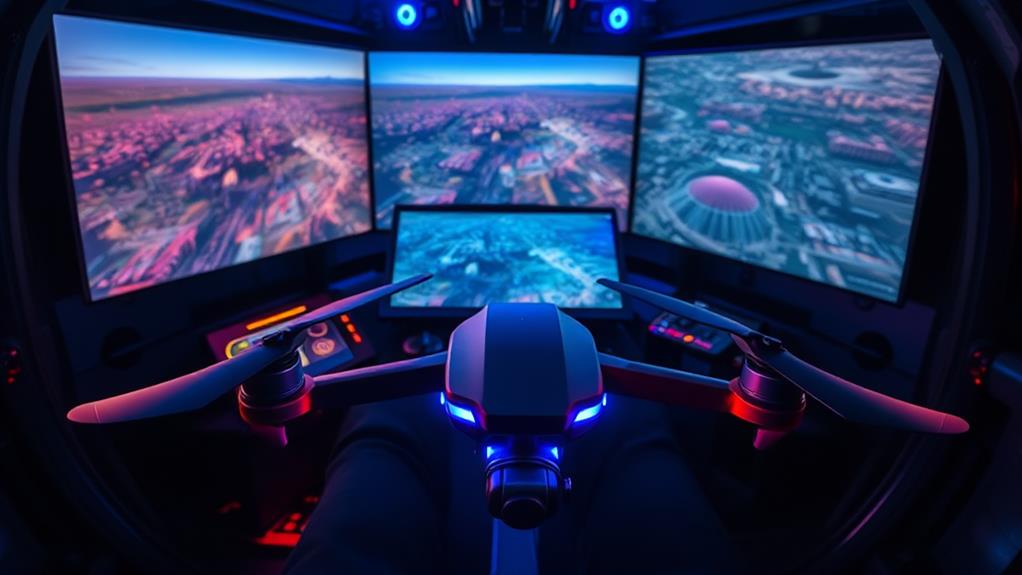
FPV simulators offer a fantastic way to enhance your drone flying skills without any risk of damaging real equipment.
These simulators are especially beneficial for beginners, as they allow users to practice on beginner-friendly models and maintain control in various scenarios.
By choosing the right simulator and customizing it to your preferences, you can practice essential maneuvers and build muscle memory effectively.
Regular practice in these virtual environments can translate to increased confidence and precision when you take to the skies with your actual drone.
Benefits of FPV Simulators
Drones offer thrilling possibilities, but mastering their control can be intimidating. That's where FPV simulators come in, providing a safe space for you to practice complex maneuvers and hone your flying skills without the risk of damaging real drones.
These simulators mirror realistic physics and flight dynamics, making it easier for you to translate what you learn into actual flying scenarios.
Here are some key benefits of using FPV simulators:
- Risk-Free Practice: Hone your skills without the fear of crashes.
- Customizable Settings: Adjust wind conditions and drone sensitivity to fit your training experience.
- Accelerated Learning Curve: Gain confidence in flying faster than traditional methods.
- Realistic Flight Dynamics: Experience the true behavior of FPV drones.
- Community Engagement: Compete with friends and connect with fellow enthusiasts via leaderboards.
Choosing the Right Simulator
When it comes to choosing the right simulator for your training, you'll want to take into account several key factors that can enhance your flying experience. First, consider the realism of the FPV simulators available. Look for those that feature realistic physics and controls, as they closely mimic actual drone flight. This realism helps you shift smoothly to real-world flying and develop essential flying techniques.
Next, explore the adaptability of the simulator. Many offer various environments and weather conditions, allowing you to practice handling diverse scenarios. This adaptability is vital for mastering skills to the limit and preparing for unexpected challenges.
Don't overlook the value of multiplayer modes. Competing with others in real-time can greatly enhance your training experience, fostering friendly competition and shared learning. Simulators like LiftOff and DRL Simulator provide these engaging features, making your practice sessions more exciting and effective.
Ultimately, utilizing FPV simulators can dramatically accelerate your learning curve, enabling you to master complex maneuvers and improve your overall flying proficiency more quickly than traditional training methods.
Choose wisely, and you'll set yourself up for success in the world of drone flying.
Enhancing Real-World Skills
Using FPV simulators can greatly enhance your real-world flying skills by providing a safe environment to practice and refine your techniques. These simulators replicate realistic flying conditions, allowing you to learn advanced maneuvers without the risk of damaging your drone.
By regularly using FPV simulators, you'll develop muscle memory and reflexes essential for maintaining control in real-world scenarios.
Here are some key benefits of utilizing FPV simulators to enhance your flying skills:
- Safe experimentation: Try flips, rolls, and precision navigation without fear of crashes.
- Customizable settings: Adjust flight physics and conditions to suit your skill level and preferences.
- Confidence building: Regular practice boosts your overall confidence as a pilot.
- Reduced learning curve: Studies show pilots can perform maneuvers 30% more effectively in real-world situations after simulator practice.
- Skill variety: Hone your skills across various aircraft types and environments.
Incorporating FPV simulators into your training routine not only prepares you for competitive events but also sharpens your control and adaptability in flying, greatly enhancing your overall experience as a drone pilot.
Understanding Drone Dynamics
To master drone flight, you need to grasp how control inputs affect your drone's behavior in the air.
Understanding flight stability is essential, as a well-balanced drone responds more predictably, allowing you to make precise maneuvers.
Additionally, knowing about different flight modes can help you adapt your flying style to various conditions, enhancing your overall control and performance.
Control Inputs Explained
Understanding how control inputs work is essential for anyone looking to master drone flying. As a drone pilot, you'll rely on joystick movements to send precise directional and speed requests. Unlike traditional aircraft, DJI drones utilize an advanced control system that translates your inputs into specific flight commands. This means you can maintain position even in challenging conditions, such as windy weather when using GPS mode.
Here are some key aspects of control inputs to take into account:
- Altitude Management: Control your drone's height effectively.
- Roll, Pitch, and Yaw: Manipulate these axes for smooth maneuvers.
- Sensitivity Development: Regular practice enhances your reactions.
- Flight Time Optimization: Better control inputs can extend your operational time.
- Basic Flight Mastery: Understanding fundamentals aids in advanced techniques.
Familiarity with these control inputs boosts your confidence while flying a drone. By honing your skills, you'll develop muscle memory that leads to smoother and more controlled flight maneuvers.
This understanding not only enhances your flying accuracy but also guarantees that you can counter environmental factors, allowing for a more enjoyable flying experience overall.
Drone Flight Stability
Achieving flight stability in a drone hinges on several key factors, primarily its center of gravity. A well-balanced center of gravity prevents unwanted tilting or erratic movements during drone flight.
When you control the drone using the control stick, understanding the dynamics of pitch, roll, and yaw is essential for maintaining stability and executing precise maneuvers.
The onboard flight controller plays an important role by processing real-time data from sensors. This allows it to adjust motor speeds, ensuring stability even in challenging wind conditions.
For beginners, drones equipped with GPS mode can utilize satellite signals to stabilize their position, counteracting external factors like wind. This feature makes for a smoother flying experience, allowing you to focus on learning.
Advanced drones often include gyroscopes and accelerometers that continuously measure orientation and motion changes, further enhancing flight stability.
By familiarizing yourself with these elements, you'll be better prepared to handle various flying scenarios, giving you the confidence to tackle your drone training effectively.
Understanding these dynamics will ultimately lead to improved control and a more enjoyable flying experience.
Understanding Flight Modes
Mastering the various flight modes is essential for enhancing your drone experience and ensuring safe operation.
Understanding flight modes helps you adapt to different scenarios, whether you're a beginner or an experienced pilot.
Here are some key flight modes to know:
- GPS Mode: Stabilizes your drone's position, making it easier to control, especially in windy conditions.
- Altitude Hold mode: Keeps your drone at a specific height, perfect for aerial photography without constant adjustments.
- Follow Me: Allows the drone to automatically track and follow you, freeing you to focus on capturing footage.
- Waypoint: Lets you set predetermined paths for the drone, enabling complex maneuvers without manual control.
- Manual Mode: Designed for experienced pilots, offering complete control over the drone's movements.
Practicing High-Speed Maneuvers
Practicing high-speed maneuvers demands a solid grasp of how your drone reacts to control inputs, particularly in manual mode where you're in complete command of pitch, roll, and yaw.
Start by establishing a consistent forward speed using the right control stick. As you maintain that speed, integrate turns and directional changes to enhance maneuverability.
Utilizing wide-open areas for practice is vital for safety; it allows you to focus on executing high-speed maneuvers without the risk of encountering obstacles. This environment guarantees smooth shifts between different flight patterns.
Incorporate advanced techniques like bank turns and coordinated rolls to improve precision and control during high-speed flying. Gradually increase the complexity of your maneuvers as your confidence builds.
Always monitor battery levels and environmental conditions. Low battery or adverse weather can negatively impact performance during your practice sessions, which could lead to safety issues.
By focusing on these aspects, you'll not only enhance your skills but also guarantee a safe and effective training experience.
Precision in Aerial Control
High-speed maneuvers build a solid foundation for your aerial skills, but precision in control takes your flying to the next level. As a drone pilot, mastering the four primary control inputs—roll, pitch, yaw, and throttle—is essential for achieving precision in aerial control.
Each input dictates your drone's movement and orientation, allowing for smooth and controlled maneuvers.
To enhance your skills, consider these key practices:
- Utilize GPS Mode to counter external factors like wind.
- Maintain a constant speed by holding the control stick steady.
- Practice basic maneuvers, including controlled ascents and descents.
- Engage in regular practice sessions to build muscle memory.
- Focus on sensitivity and responsiveness to control inputs during flight.
Safety Considerations in Training
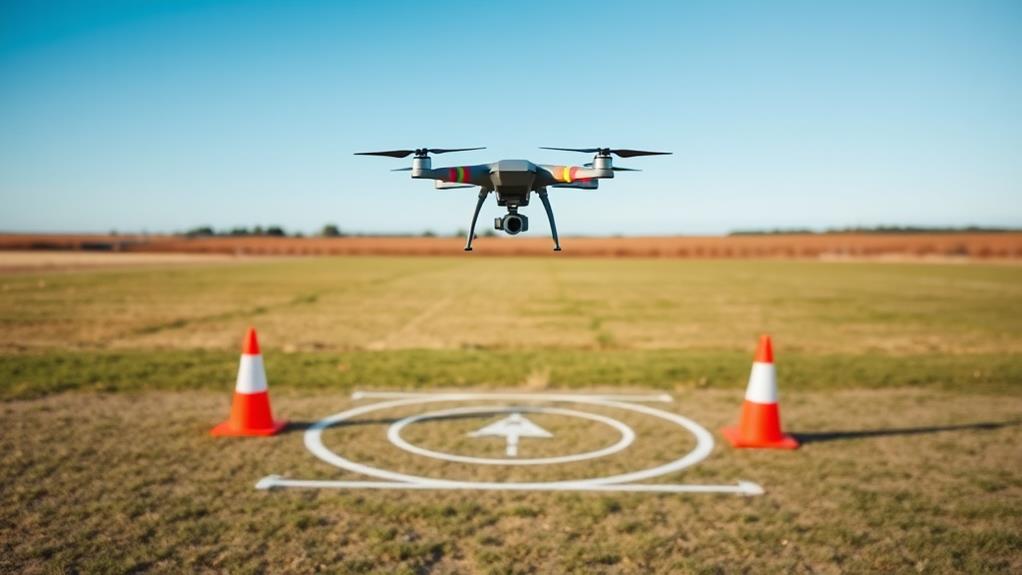
Safety is paramount when it comes to drone training. To guarantee a successful experience, you must prioritize safety considerations throughout your sessions.
Always maintain a safe distance from people, animals, and private property to minimize risks during your flights. This not only protects others but also safeguards your drone.
Monitoring weather conditions is vital, too. Avoid flying in high winds or precipitation, as these can greatly affect your drone's performance and control.
Before each flight, conduct thorough pre-flight checks, inspecting your drone for damage and confirming that the firmware is up to date.
Utilizing drone safety features, like GPS tracking and obstacle avoidance systems, can enhance safety during your training.
Familiarizing yourself with lost drone protocols is also essential. Knowing how to use the Return-to-Home function can help you recover your drone quickly if you lose signal, preventing potential loss.
Tracking Progress and Improvement
After prioritizing safety in your drone training, it's time to focus on how you can effectively track your progress and improvement.
Monitoring your journey will help you identify areas for enhancement and maintain motivation. Here are some strategies to reflect on:
- Keep a flight log: Document your flight hours, maneuvers practiced, and conditions faced. This will be invaluable for tracking progress.
- Set specific goals: Aim to master a new maneuver within a set timeframe. Measurable goals keep your focus sharp.
- Engage in practice sessions: Regular practice is essential. Focus on basic maneuvers to build muscle memory and improve your flying.
- Utilize FPV simulators: These provide a risk-free environment to practice advanced maneuvers and gauge your skill level before real-world flying.
- Seek community feedback: Join local drone clubs or online forums. Constructive criticism from others can enhance your skills and provide new insights.
Conclusion
By mastering speed and control in drone training, you're not just flying; you're soaring like a superhero in the sky. Implementing essential techniques and utilizing FPV simulators will elevate your skills to dizzying heights. Understanding drone dynamics and practicing high-speed maneuvers turns you into a precision pilot, steering through the air like a seasoned pro. Remember, safety is key, so track your progress and keep pushing your limits. With dedication, you'll become the drone master everyone admires!
Leave a Reply